
Thai steamed fish with lime and garlic is a classic of Thai cuisine. In Thailand, it is known as Pla Neung Manao, which literally means "steamed fish with lime". I've already shared a recipe for squid prepared in a similar way, but I've recently discovered one special ingredient that takes this dish to another level. So it was definitely time to share this discovery with you.
Whenever we eat out, we almost always order steamed fish or Tom Yam. It makes a nice change from many other Thai dishes, which are often fried or served with sauces containing a lot of sugar. If you order this dish at a restaurant in Thailand, be warned: it can be extremely spicy, with the fish almost completely covered in chopped chilies.
✨ Last updated: July 2026
I have expanded this Thai steamed fish recipe with tips on choosing the right fish, adjusting the cooking time, and making a successful lime and garlic sauce.
J’ai toutefois conservé les anecdotes sur ma vie en Thaïlande telles que postées il y a plus de 10 ans, bien que j’aie maintenant une jolie maison bien à moi et que je n’enseigne plus.
The Story Behind This Famous Thai Steamed Fish with Lime and Garlic
Nan m’a souvent parlé du poisson à la vapeur préparé par une de ses sœurs. “Hers is much better than this one,” que j’entendais à tout-vent !
Du coup, comme j’ai eu de la visite de Suisse, et que mes amis arrivaient tard le soir, trop tard pour aller au restaurant, j’ai engagé la fameuse sœur de Nan pour préparer notre repas. Je ne voulais pas passer mon temps en cuisine. Je voulais profiter de la soirée avec mes amis. Elle l’a bien compris, et c’est sans scrupules qu’elle m’a taxé, à elle toute seule, le salaire qu’on paierait à toute une équipe de cuisine ! 😆
Anyway, we put the menu together: steamed fish with lime and garlic, crab with yellow bean sauce, and stir-fried squid with pepper.
I had the chance to watch her prepare everything and, naturally, spent quite a bit of time snooping around the kitchen while she cooked. That's how I discovered the magic ingredient that makes her sauce taste so good: pickled garlic.
Thai Pickled Garlic
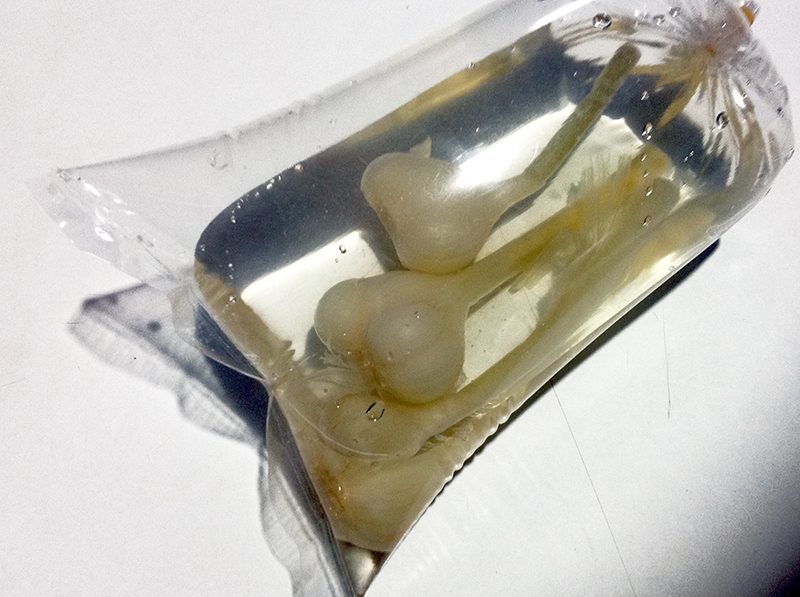
Thai pickled garlic is usually easy to find in Asian grocery stores. The pickling liquid is tangy, salty, and slightly sweet. Nan's sister uses both fresh garlic AND pickled garlic, and she also adds some of the pickling liquid directly to the sauce for the fish.
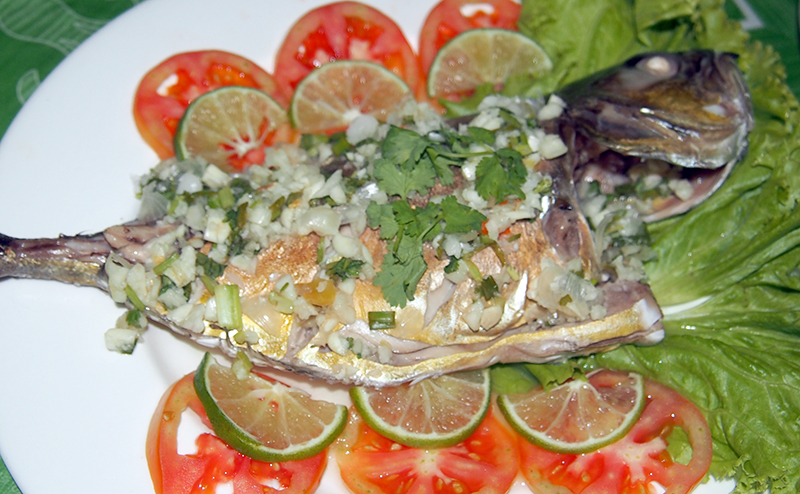
I have to admit, her fish really was delicious. So were the other dishes, actually. She's one hell of a good cook!
She even had the courtesy to wait until the end of the meal before hitting me with the bill. At least that gave me time to enjoy the crab and fish before developing an ulcer!
Le lendemain, elle a appelé Nan pour lui faire remarquer que j’avais reçu beaucoup de chocolat de Suisse et qu’elle y goûterait bien ! Mouhahahahahah ! 😂😂😂😂
Nan really does have fantastic sisters!
🧄 The Ingredient That Changes Everything
This recipe uses both the pickled garlic cloves and their brine. This slightly sweet, salty, and tangy liquid balances the lime juice and gives the sauce greater depth of flavour. Pickled garlic is generally available from Asian grocery stores.
Our New Home
Now for a complete change of subject — let me tell you what happened next with my move. In Thailand, when you're a teacher, you have a certain authority over your students. Equality and freedom are rather vague concepts here. Social hierarchy is very noticeable, and authority is deeply respected. For me, that was difficult. I never really got used to bowing my head to people I didn't know — or even people I did know, for that matter — simply because they had more money than me or because they worked for the municipality or the local police. I also struggled with the fact that my students behaved that way towards me. It felt strange to teach a class where nobody ever talked back. When I gave an instruction, nobody argued.
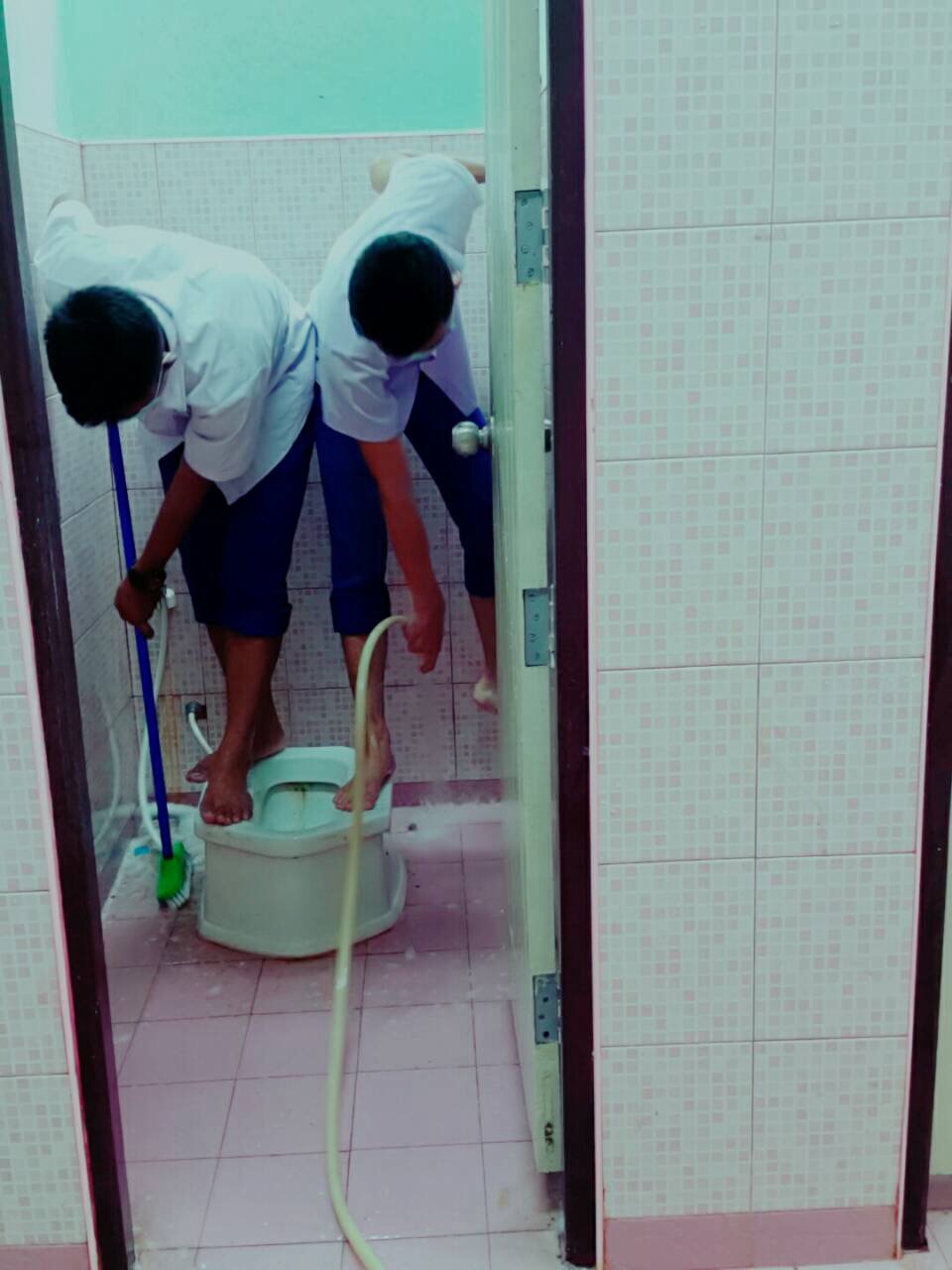

I could have asked a student to go and wash my car in the school parking lot during class, and they would have done it without complaining (that's just an example, I promise — I never actually had the nerve to ask them to do that!).
Some of my colleagues had students mark tests for them to save time. Whenever we had a meeting, a group of students would be selected to prepare the room, serve drinks, and clean everything up afterwards.
Basically, the students were there to help us. It was considered completely normal. There wasn't a caretaker or a cleaning team because there was plenty of free manpower available!
At school, students were taught obedience. Not much independent thinking, questioning, or rebellion. Shocking, right? So when I moved house and needed to repaint the place, my colleagues — and Nan too — told me: "Ask a group of students." Okay... the idea didn't seem entirely crazy. After all, I could probably manage a group of students more easily than a group of Thai construction workers (and believe me, I have stories about that too!). Then my colleagues added: "And you don't even have to pay them!"
Time to Get to Work!
WHAT???? Are you kidding me? You expect me to make my students work at my house all weekend without even paying them? Apparently, I was the only person bothered by the idea, because when I asked my students if they wanted to come and help paint my house, they were delighted — and they initially refused to be paid.
They offered me a deal: six of them would come and paint my house for two days, on one condition — I had to let two of them pass the semester because they were currently failing. I was so impressed by this group of friends volunteering to work for free just to help their buddies pass the year that I accepted the deal! (Anyway, Thai public school was a little like L'École des Fans: in the end, everybody wins and nobody really fails.)
Six of them turned up.
Six big 18-year-old guys, ready to repaint my house for two days. And they worked incredibly hard. No laziness, no slacking off — they worked like crazy from 8 a.m. until 4 p.m. I was speechless!!
Here are a few before-and-after photos:

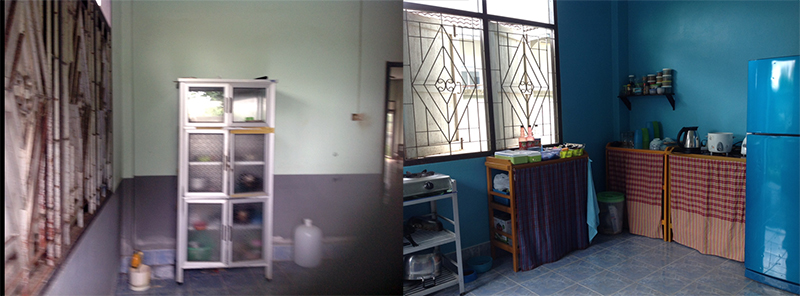
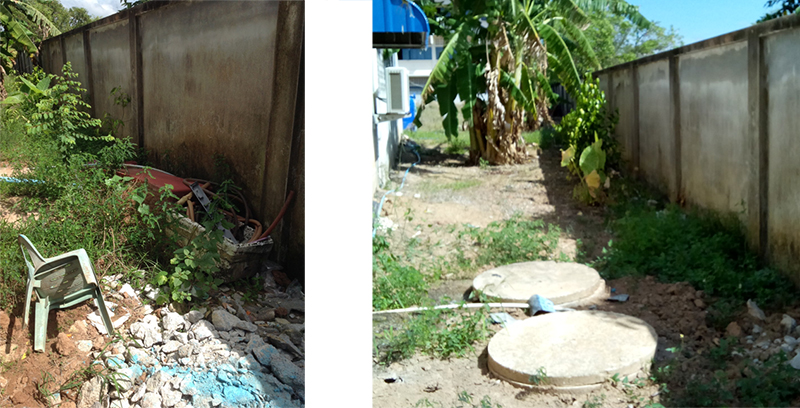
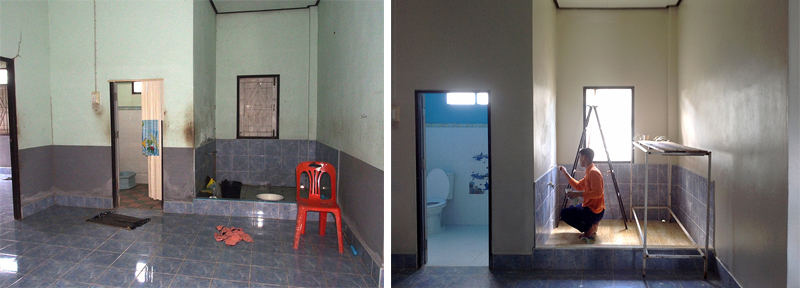
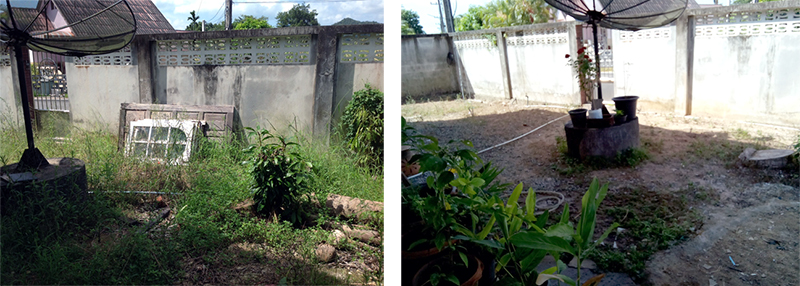


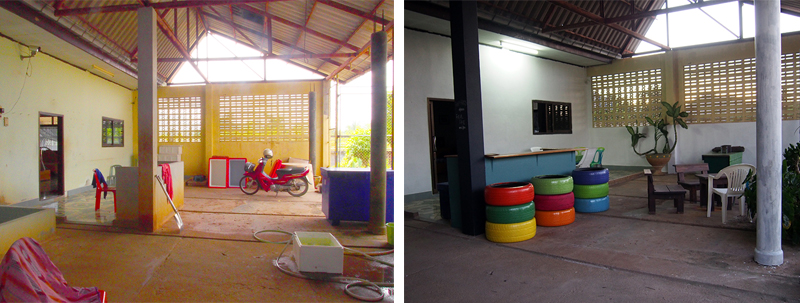
They did such a great job that in the end, I decided to pay them anyway — partly to make my conscience feel a little better. I paid them 200 baht per person, per day: 200 baht was about €5! Except for the two who had negotiated their way through the semester (you can't be a teacher without having at least a tiny sadistic streak) — those two only got paid for one day!
By the end of the weekend, they were exhausted but happy. They devoured the crêpes I made for them — the first they had ever tasted.
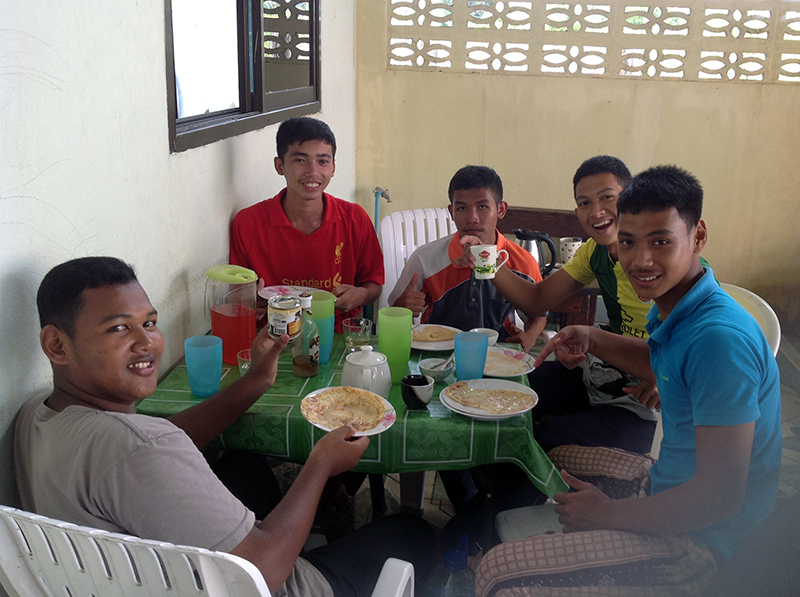
A Change in Attitude
They even agreed to come back the following weekend to clean up the garden, happy to earn a little pocket money.
And you know what? From that weekend on, those six big guys who used to spend most of their time sleeping at the back of my classroom suddenly started sitting in the front row and doing their best to speak English! Somehow, they woke up the rest of the class too. No more missing homework, no more absenteeism! All because I exploited them for a weekend... Amazing Thailand!
Now imagine the same situation in Switzerland: you'd have every parent in the school after you, you'd get an official warning from the school administration, and you'd probably end up being talked about in the local newspapers. With a bit of luck, you might even find yourself explaining the whole thing to the authorities!
All these crazy stories have made me hungry, so it's time to show you how to prepare that famous steamed fish with what must surely be the most expensive sauce in Thailand!
Enough chatting—back to the recipe!
What Kind of Fish Should You Use for Pla Nueng Manao?
In Thailand, Pla Nueng Manao is usually prepared with a whole fish with tender white flesh, such as snapper, grouper, or mullet. In Europe, you can use sea bass, sea bream, or any other whole fish small enough to fit inside your steamer.
Ask your fishmonger to gut and scale it for you. Cooking the fish whole keeps the flesh particularly tender and moist, but you can also prepare this recipe with fillets by reducing the cooking time.
How Long Should You Steam a Whole Fish?
The cooking time depends on the weight of the fish, but especially on its thickness. A medium-sized whole fish will generally take between 15 and 20 minutes once the steamer is producing plenty of steam..
To check whether it is cooked, gently separate the flesh at its thickest point, close to the central bone. It should be opaque, come away easily, and remain moist. If it is still translucent, steam it for another two to three minutes.
Avoid overcooking the fish, as its flesh will continue to firm up and may become dry.
More Steamed Recipes
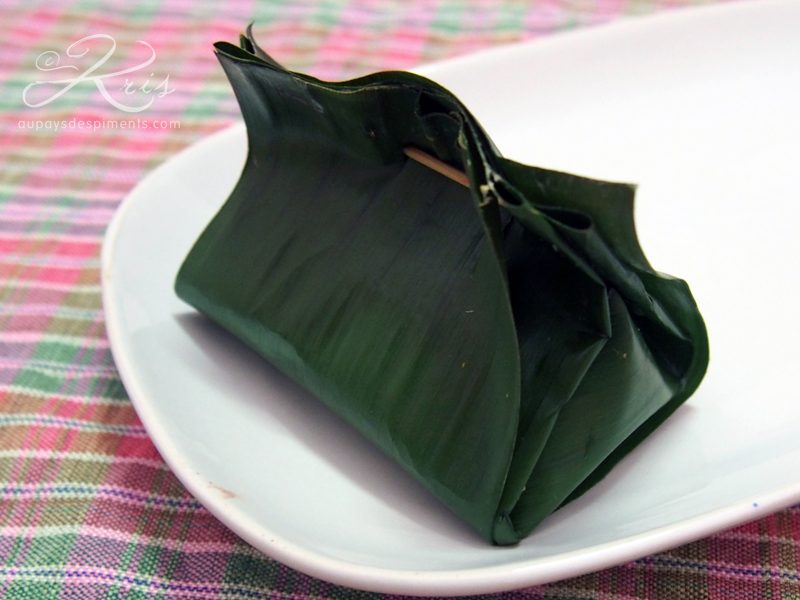
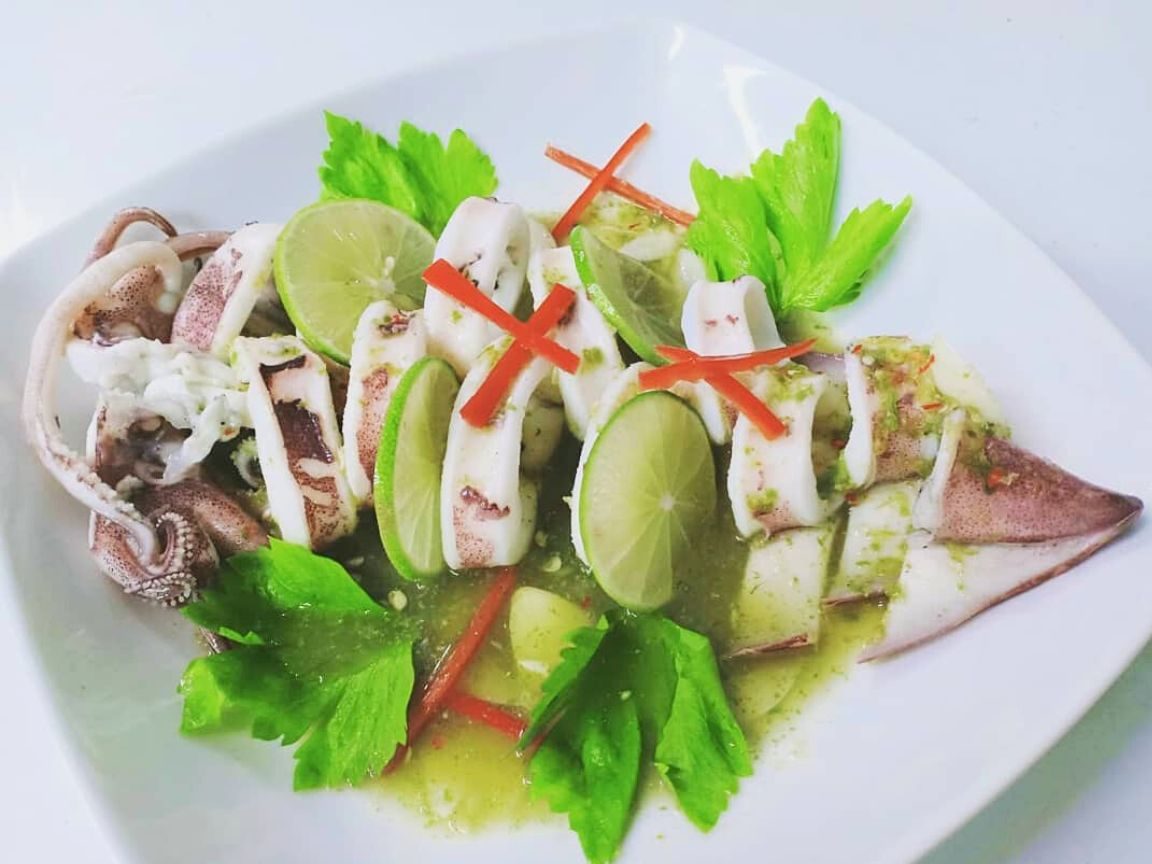
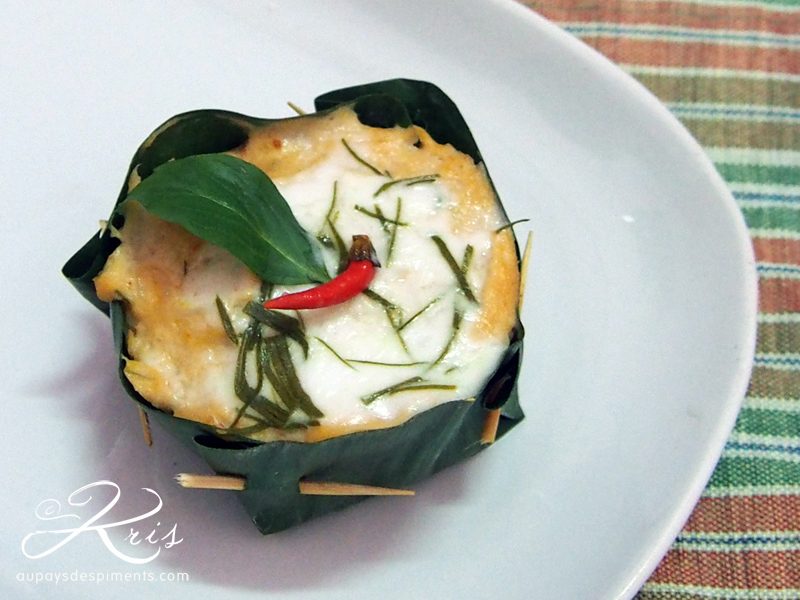
🇹🇭 In Thailand
In restaurants, Pla Nueng Manao is often served very spicy, with a generous amount of finely chopped fresh chillies. You can, of course, adjust the quantity to suit your taste, but try to include at least a little if possible: the heat is part of the balance between the sour, salty, sweet, and spicy flavours that characterise this sauce.
How to Make the Perfect Thai Lime and Garlic Sauce
The sauce for Pla Neung Manao should be tangy, salty, very slightly sweet, and spicy. Start by mixing the lime juice, fish sauce, sugar, and pickled garlic liquid. Taste the sauce before adding the fresh garlic, pickled garlic, and chilies.
The lime should remain the dominant flavor, but the sauce shouldn't be aggressively sour or overly salty. Adjust it with a little more sugar, fish sauce, or lime juice until you find the balance that tastes right to you.
🌶️ The amount of garlic may look like a lot, but whatever you do, don't reduce it. I promise you, it's absolutely perfect this way. 🌶️ As for the chilies, adjust the amount to suit your taste. I've used a fairly small amount. If you want to make it the way it's typically served in Thailand, you'll need at least 3 to 4 tablespoons of chopped chilies.
🍽️ What to Serve with Thai Steamed Fish
In Thailand, this fish is usually placed in the center of the table and served with jasmine rice alongside several other dishes to share. For a simple meal, you can serve it with fragrant rice and some stir-fried or steamed vegetables. And don't hesitate to spoon some of that lime sauce over the rice — it's almost as important as the fish itself.
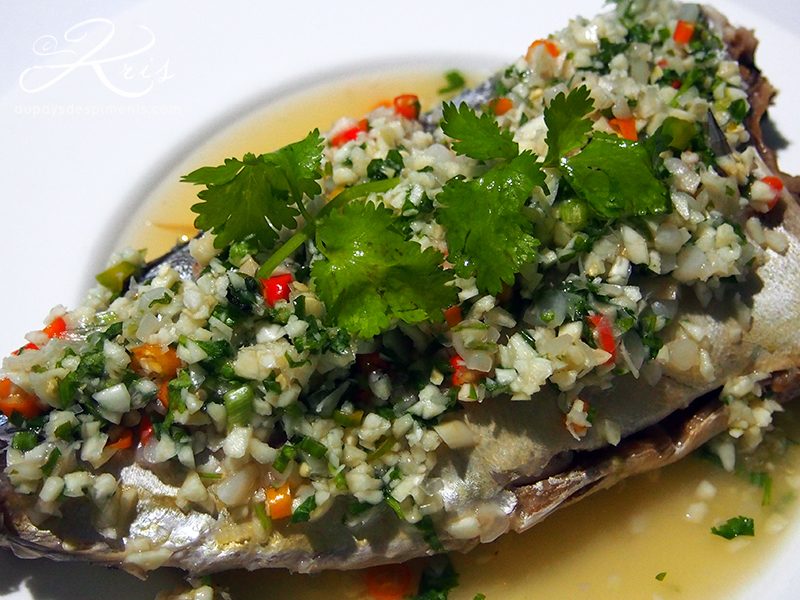
Thai Steamed Fish with Lime and Garlic – Pla Neung Manao
Ingredients
- 1 whole fish with tender white flesh scaled and gutted
- 1 thumb-sized piece of ginger
- 2 stalks of lemongrass
- 6 tbsp of lime juice
- 2 tbsp of garlic , chopped
- 1 tbsp of chillies , chopped
- 1,5 tbsp of pickled garlic , chopped
- 3 tbsp of pickled garlic liquid
- 1 tbsp of fish sauce
- 2 tsp of sugar
- salt
- 1 to 2 tbsp of fresh coriander leaves chopped
- 1 to 2 tbsp oignon vert , finely sliced
Instructions
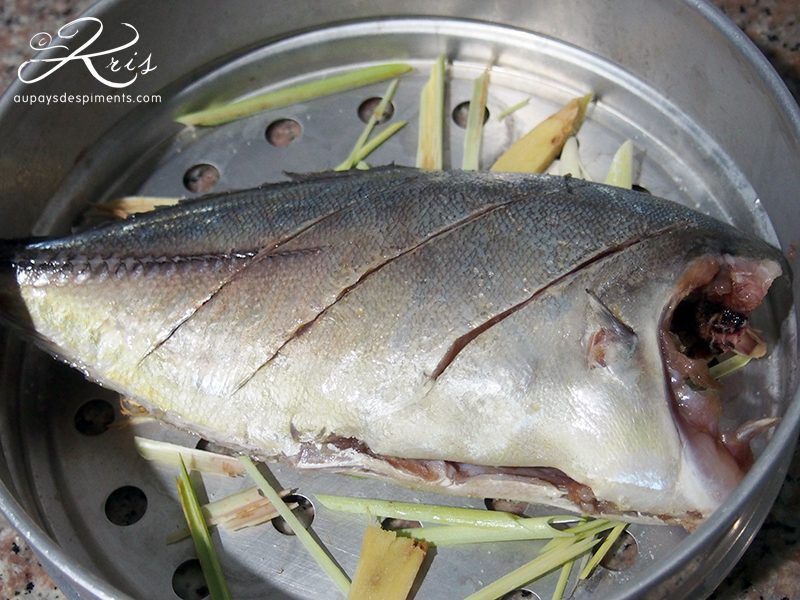
- Peel the ginger and cut it lengthwise into thin slices.
- Arrange the ginger slices in the bottom of your steamer basket.
- Remove the tough outer leaves from the lemongrass. Bruise the stalks with the flat side of a knife, then cut them into 4–5 cm (1½–2 inch) pieces.
- Arrange the lemongrass in the bottom of the steamer basket.
- Rinse the fish and rub the inside with a little salt. Make a few diagonal cuts on both sides of the fish.
- Place the fish on top of the ginger and lemongrass and steam until cooked through. Depending on the size and thickness of the fish, this will take approximately 10–20 minutes.
Meanwhile, prepare the sauce:
- Mix together the lime juice, fish sauce, sugar, and pickled garlic liquid. Taste and add salt if needed.
- Add the fresh garlic, pickled garlic, chilies, cilantro, and green onion. Mix well.
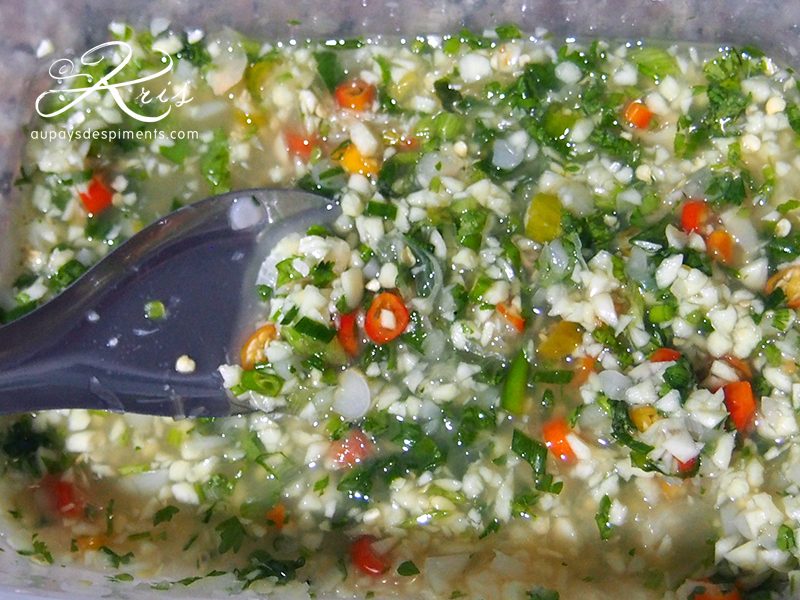
- Once the fish is cooked, transfer it to a serving dish and spoon the garlic and lime sauce generously over the top, making sure some of the sauce gets into the cuts in the fish.
- Serve immediately.
Frequently Asked Questions About Thai Steamed Fish with Lime and Garlic
Yes. Depending on their thickness, fish fillets will usually take 6 to 10 minutes to steam. Keep a close eye on them, as fillets can dry out more quickly than a whole fish.
You can make the recipe using only fresh garlic, but the sauce won't have quite the same depth of flavor. In that case, add a little extra sugar to balance the acidity of the lime, without trying to replicate the exact flavor of the pickled garlic liquid.
It's best to steam the fish just before serving. However, you can prepare the sauce and aromatics ahead of time and keep them separately in the refrigerator until you're ready to cook the fish.
The flesh should be opaque and come away easily from the bone at the thickest part of the fish. It should still look moist and glossy rather than dry.
 English
  Français
Quelle belle recette ! Et très facile à faire (une fois l’ail en pickles trouvé !). Très bel et très interessant article aussi sur l’organisation de la société thaïe.. Un immense merci pour ces partages 🙂
ça doit juste être délicieux…
Super. Je retiens, j’ai hâte d’essayer. Merci, bonne journée.
Merci. Dis-moi ce que tu en penses lorsque tu auras essayé 😀
Hello!
Merci pour cette recette qui a l’air top! Il faut juste trouver de l’ail en pickles en France maintenant!!! Ça me rappelle un peu le poisson au gingembre qu’on a dégusté à Koh Lanta il y a un an, c’était vraiment super bon.
J’ai beaucoup aimé lire vos péripéties avec vos élèves, c’est dingue comme la culture est vraiment différente de la notre. En voilà des gamins respectueux, ça change d’ici!
J’aime beaucoup votre cuisine et particulièrement la couleur bleue ds murs, très moderne!
Bonne continuation à vous.
Merci pour tout ces retours super positifs !
Effectivement, la culture thaïe est complètement différente de la notre. J’habite ici depuis longtemps mais je continue à avoir des surprises régulières.
Tous les poissons au gingembre que j’ai eu l’occasion de manger dans la région étaient d’abord frit puis recouverts d’une sauce au gingembre.
Celui que vous avez mangé était cit à la vapeur ? mhhhhhhh, ça m’intéresse ….
Je comprends mieux ,en relisant tes dernières lignes, l’état d’esprit thaï,et surtout l’arnaque de ta cuisinière. A ses yeux, tu es riche.
C’est à se demander s’ils ont de la moralité. J’espère que cette fois-ci sera la bonne, et que l’on ne parlera plus de déménagement pendant longtemps
Sinon,c’est un peu facile, c’est à dire:::je loue……je laisse « »les autres » » retaper et remettre propre………et je les éjecte,pour prendre la place dans un logement remis à neuf.
Heureusement,que vous avez eu un sérieux coup de main.
Je suis contente pour toi.
Je devais t’envoyer un message, mais il y eu des problèmes à la maison, (je t’expliquerai),et comme toujours j’étais sur la brèche.
Je t’embrasse. Chris 06
Coucou Chris,
Tu vois, comme d’habitude, il me faut des plombes pour te répondre 😀
J’espère que tout va bien de ton côté.
A bientôt pour une nouvelle recettes
Becs
Kris
C’est donc l’ail en pickles, j’ai failli attendre 😉
Très intéressant ton billet, sur le rapport au travail en Asie, entre la frangine qui t’arnaquent et les élèves qui te refont une super-maison presque par devoir, c’est un assez joli résumé de l’Asie. Le plus beau étant le résultat de toute ta classe après ce moment où tu as donné ta confiance « privée » à quelques-uns d’entre eux.
qui t’arnaquE
ha ! J’ai pensé que tu réformais ta façon d’écrire 😉
J’ai été surprise par ta patience, je m’attendais à avoir des rappels et d’autres menaces 😉
Bah oui, en fait c’est juste de l’ail en pickles, rien de bien spécial si ce n’est que c’est la première fois que j’en utilise.
Il semblerait qu’on peut en ajouter dans le pad thai (ça tombe bien j’aime pas ça) et dans certaines soupes, il va falloir que je trouve d’autres recettes pour utiliser le solde ! Si tu as des idées, je prends !
Les élèves recherchent le contact avec les enseignants, beaucoup plus qu’en Europe. L’enseignant est encore perçu comme une personne importante dans la société – d’ailleurs, ici, personne ne m’appelle par mon nom, on m’appelle « Krou », c’est le titre qu’on donne aux enseignants (comme le titre de « docteur » ou de « professeur ») – du coup, ces jeunes sont très fiers de profiter d’activités spéciales avec leur prof. Mes élèves de 18 ans, réagissent comme réagiraient des élèves de 8 ans chez nous. Ils sont morts de rire quand je fais des jeux de mots ridicules qui déclencheraient des commentaires narquois de la part d’ados suisses. Ils sont également très reconnaissants. Ils ne sont pas très cultivés ni originaux. Ils n’ont pas un esprit rebelle ou indépendant mais ils s’organisent bien et ils coopèrent beaucoup.
Cela reflète parfaitement la société thaïe !
Quand au rapport à l’argent … pffff… il me faudrait 10 blogs pour le décrire en détail. C’est souvent déprimant! Mais ce qui me rassure c’est que ce n’est pas parce que je suis étrangère (donc forcément riche), ils se font plein de coups pourris entre-eux.