
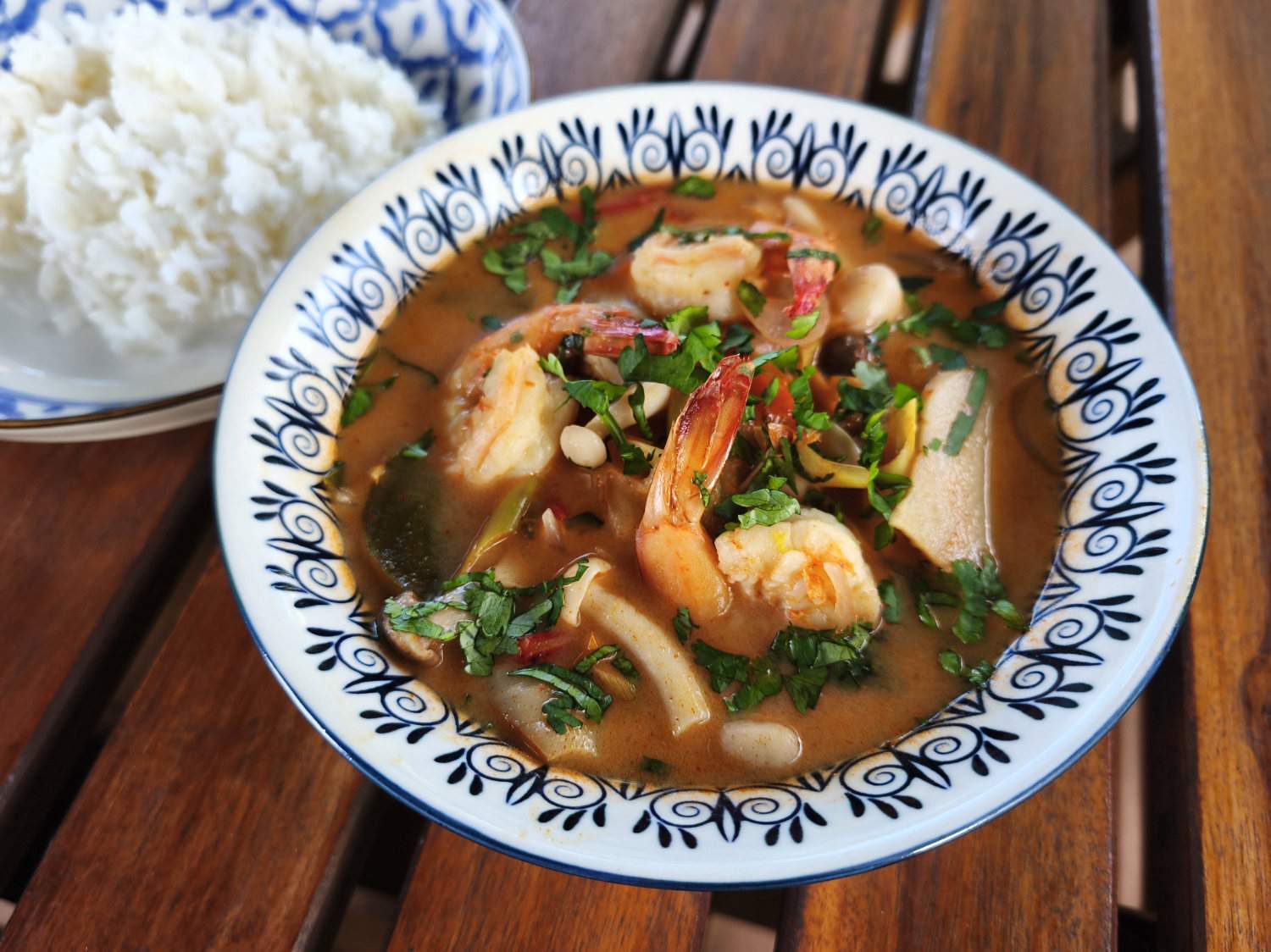
Le Tom Yum Goong,also spelled Tom Yam Kung, is a hot and sour Thai shrimp soup flavoured with lemongrass, galangal and makrut lime leaves. In this recipe, I make Tom Yum Nam Saithe traditional clear-broth version, without coconut milk or evaporated milk.
This Thai shrimp soup gets its perfect balance of flavours from fish sauce, lime juice, chillies and aromatic herbs. It is made with a rich homemade shrimp stock and can be served with fragrant jasmine rice and a Thai omelette.
Here is a little backstory: the first time I made this soup, Nan promptly told me off. He explained that I had made a Bangkok-style Tom Yum, even though we live in southern Thailand. You simply cannot mix the two!
According to him, my Tom Yum was nowhere near bold enough for southern Thai tastes. He added more lime juice and fish sauce, threw in a little more chilli, and then asked me to taste it again… Much to my dismay—and with my pride slightly bruised—I had to admit that it was absolutely perfect!
So here is the recipe with the chef’s adjustments: a Tom Yum made to suit southern Thai tastes.
Tom Yam or Tom Yum: Which Spelling Should You Use?
Tom Yam and Tom Yum refer to the same soup. The different spellings simply come from the various ways Thai words can be written using the Latin alphabet. The shrimp version may also be called Tom Yam Kung, Tom Yum Goong or Tom Yam Goong.
What Is the Difference Between Tom Yum Nam Sai and Tom Yum Nam Khon?
Le Tom Yum Nam Saifeatured on this page has a clear, light, hot and sour broth. Tom Yum Nam Khon is richer and creamier thanks to the addition of nam prik pao and unsweetened evaporated milk. Neither version traditionally contains coconut milk. In a classic Thai Tom Yum Nam Khon, unsweetened evaporated milk is generally used instead. You can find my Tom Yum Nam Khon recipe here.
🍜 Which Version Should You Choose?
Choose Tom Yum Nam Sai if you are looking for a light, vibrant and intensely tangy soup. Go for Tom Yum Nam Khon if you prefer a richer, milder and slightly creamy broth.

✨ Last updated: July 2026
This recipe has been completely updated with more detailed explanations of the traditional ingredients, the different Thai variations and plenty of tips drawn from my experience living in Thailand.
Garcinia: A Tangy Fruit
To give Tom Yum its characteristic sourness, you can use lime juice, tamarind concentrate or a few slices of dried garcinia. In Thai, this fruit is called som khaek..
In southern Thailand, it is traditionally used in certain sour dishes when limes are scarce or expensive. If you find some in an Asian grocery shop, add two or three slices to the soup. It is not essential, however: lime juice works perfectly well.

Tips for Making Tom Yum
🌶️ As the base of this soup is a stock, you can use a ready-made fish or poultry stock, but a homemade shrimp stock will give you the best flavour.Whenever I cook shrimp, I save the heads and shells in the freezer and use them later to make stock. You can also buy stock cubes made especially for Tom Yum, but homemade stock tastes much better.

🌶️ Tom Yum is flavoured with plenty of aromatic herbs, but they are not usually meant to be eaten. Simply push them aside as you enjoy the soup.
🌶️ Do not simmer the lemongrass, galangal and makrut lime leaves for too long, as the soup would lose the fresh, vibrant aromas they provide.
Lately, I have been cooking some of the galangal and lemongrass in the stock with the shrimp shells, allowing them to simmer and develop a deeper flavour. I then strain the stock before using it to make the Tom Yum. At the last minute, I add fresh lemongrass, galangal and makrut lime leaves. This method produces a rich, deeply flavoured broth while preserving the bright, fresh aromas of the herbs.
How to Make Homemade Shrimp Stock
Place 1 litre of water in a saucepan with the shrimp heads and shells. Add 3 crushed garlic cloves, 1 roughly chopped onion, a few slices of galangal, 2 crushed lemongrass stalks and 4–5 makrut lime leaves. Bring to the boil, then cook over medium heat for 15 minutes. Strain the stock, keeping only the fragrant liquid.
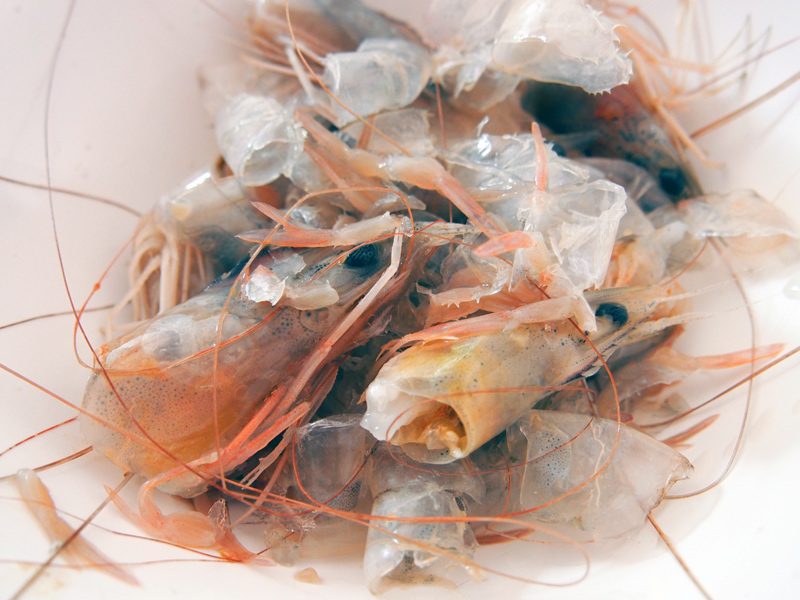

♻️ A Zero-Waste Tip
If you are not making the stock straight away, store the shrimp heads and shells in an airtight freezer bag. They will be ready to use the next time you make Tom Yum.
A Different Way to Serve Tom Yum
I once made steamed fish fillet roulades filled with shrimp hor mok. I served them with an intensely fragrant, strained Tom Yum broth. It made an absolutely delicious starter.

More Fragrant Thai Soups


🌿 The Secret to a Fragrant Tom Yum
Add the lime juice after removing the soup from the heat to preserve its fresh flavour. Avoid cooking the lemongrass, galangal and makrut lime leaves for too long. These aromatics flavour the broth but are not generally meant to be eaten.
Tom Yum Goong Nam Sai – Thai Shrimp Soup
Ingredients
- 1 litre stock shrimp, fish or vegetable
- 600 g whole raw shrimp entières
- 200 to 300 g of mushrooms (straw mushrooms, shimeji, oyster or button mushrooms)
- 4 cloves of garlic
- 4 shallots
- 8 cm of galangal
- 3 racines coriander roots (or stems without leaves)
- 6 à 8 feuilles kaffir lime leaves
- 4 stalks of lemongrass
- 5 à 10 bird chillies or to taste
- 3 small tomatoes
- 80 ml of fish sauce
- 60 ml of lime juice
- Fresh coriander leaves, chopped
Instructions
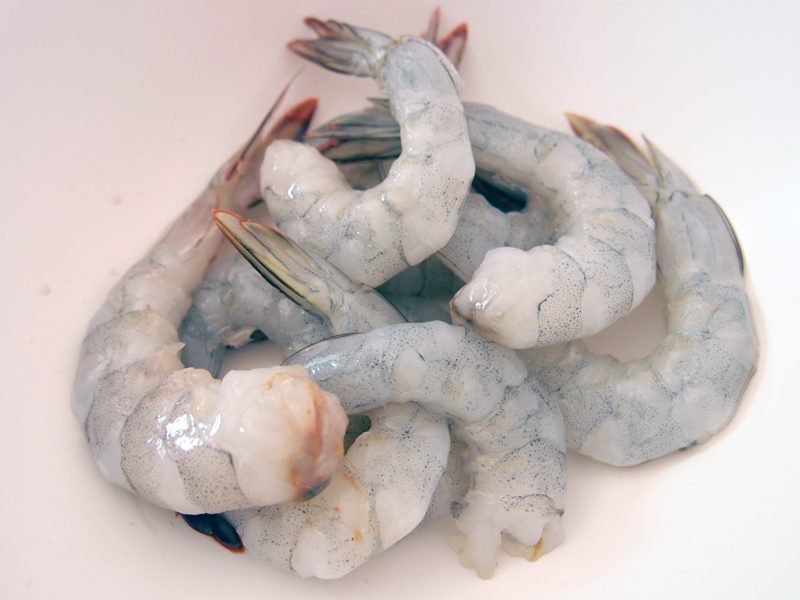
- Peel the shrimp, leaving the tails attached for presentation 🤩. Save the heads and shells to make the stock. Make a shallow cut along the back of each shrimp and remove the intestinal vein. Rinse well under running water and drain.
- Heat the stock. Add the peeled and crushed garlic, peeled and crushed shallots, scrubbed and thinly sliced galangal, finely chopped coriander roots and roughly torn makrut lime leaves. Add as many chillies as you like, sliced in half lengthways. Finally, add the crushed lemongrass stalks, cut into 2–3 cm pieces.

- Simmer for 10 minutes to allow the aromatics to flavour the stock. Add the fish sauce and the mushrooms, cut into large pieces, then cook for another 5 minutes.

- Add the shrimp and tomatoes, cut into wedges. As soon as the shrimp are cooked, turn off the heat.

- Add the lime juice and chopped coriander leaves after removing the pan from the heat.The soup should taste quite salty and distinctly sour. Add more fish sauce or lime juice if necessary.
- Serve with fragrant jasmine rice and a Thai omelette.
Notes
Place 1 litre of water in a saucepan with the shrimp heads and shells. Add 3 crushed garlic cloves, 1 roughly chopped onion, a few slices of galangal, 2 crushed lemongrass stalks and 4–5 makrut lime leaves. Bring to the boil, then cook over medium heat for 15 minutes. Strain the stock, keeping only the fragrant liquid.
Frequently Asked Questions About Tom Yum Goong
Tom Yum is traditionally a spicy soup, but you can adjust the number of chillies to suit your taste. For a milder version, use only one or two whole chillies and avoid crushing or slicing them.
You can prepare the aromatic stock one or two days in advance and store it in the refrigerator. Add the mushrooms, shrimp, fresh aromatics and lime juice shortly before serving to preserve their texture and freshness.
Galangal and ginger have different flavours. If you cannot find galangal, it is better to leave it out than to replace it with the same quantity of ginger. However, your Tom Yum will have a less distinctive flavour.
The lemongrass, galangal slices and makrut lime leaves are primarily used to flavour the broth. They are often left in the bowl but are generally pushed aside while eating.
Makrut or Kaffir lime leaves have a very distinctive fragrance that is difficult to replicate. If you cannot find them, you can make the soup without them or add a little makrut lime or regular lime zest, avoiding the bitter white pith.
Yes, but whole shrimp allow you to make a much more flavourful stock using their heads and shells. If using peeled shrimp, choose a good-quality fish or shellfish stock.
 English
 Français
Bonjour Krys, je suis ravie de découvrir ton blog de cuisine! Ayant habité 5 ans en Asie, je suis un peu exigente et j’ai souvent du mal à trouver des recettes « riches » en français. Les tiennes sont superbes, un grand merci pour tout ce que tu partages si joliment. Je vais essayer le Tom Yam aujourd’hui – la recette précédente que j’ai déjà essayé plusieurs fois était trop fade – celle ci a l’air super! J’aime bien mettre du calamar en plus de crevettes mais à cause de Noël, les poissonniers n’en proposent pas chez moi aujourd’hui – tant pis.
Je te souhaite une belle et bonne journée au pays du soleil, Julie
Hey! Avant tout merci pour ce blog genial! Je commence a plutot bien connaitre la thailande, ainsi que d autres pays d asie, mais la cuisine thai reste ma preferee! C est juste genial de pouvoir enfin retrouver a la maison les vrais saveurs de la thailande, celles que l on degustent a nimporte quel coin de rue pour 30 baht installe sur des micro tabouret en plastique! La prochaine fois d ailleurs, je pars avec un caŕnet a remplir de recettes!
Petite question sur cette recette: tu parles a un moment de champignons, mais il n est precise nul part de quel type de champignon il s agit… Visuellement, je vois tres bien a quoi ils ressemblent, mais pourrais tu m en reveler leur nom en thai et francais? Je n arrive pas a m en souvenir! Merci d avance, et continue ainsi, ton blog est une tuerie!
Ps: j ai un ami qui est a l hopital pour un moment, et en ce moment, il me sert de gouteur pour tes recettes… Il apprecie beaucoup! Ses commentaires se resumment a « miam miam!! » Toutes les deux bouchees…! Il me fait bien rire!
Bonjour Clo,
Bienvenue au Pays des Piments.
Effectivement, j’ai fait une bouette pour les champignons, je ne sais pas pour quelle raison j’ai écrit cela puisque je n’en mets pas dans la recette. Je vais modifier sur le champ.
Maintenant, si tu veux ajouter des champis, tu peux utiliser des champignons de paris frais. Dans le nord de la Thaïlande, on y ajoute des Volvaire volvacée et dans le sud on utilise plus volontiers des pleurotes.
La Thaïlande est le paradis de la street food, c’est vrai qu’on peut manger des plats délicieux pour 3 fois rien !
Par contre, tu auras de la peine à récolter des recettes, ce n’est pas facile de réussir à faire expliquer aux Thaïs comment ils préparent tel ou tel met, les explications sont toujours confuses et c’est impossible de connaître les quantités. Je m’arrache les cheveux chaque fois que j’essaie de refaire un plat que j’ai bien aimé. Je te rassure, ce n’est pas un manque de bonne volonté ou ce n’est pas pour protéger leurs recettes, c’est juste culturel : très peu de monde cuisine en suivant une recette précise. De plus les consignes détaillées et précises (en cuisine ou quoi que ce soit d’autre) ne font pas partie de la vie locale, tout est toujours très flou, tout est toujours de l’impro.
Transmet mes bons voeux de rétablissement à ton ami hospitalisé… rien de tel que de bons petits plats pour faire passer plus vite de tristes journées à l’hôpital !
Et un grand merci pour ton sympathique message, contente que tu trouves ton bonheur gastronomique qu pays des piments !
Kris
Bonjour Kris, comme promis, me voilà en train de visiter ton blog et lire tes magnifiques recettes. Je voulais savoir si tu comptes publier une recette du Tom Yam végétarien, dont tu parles au début du billet. Je ne suis pas végét, mais j’aime me faire des recettes sans viande de temps en temps et j’ai pas mal d’amis végétariens.
Peut-on trouver les ingrédients de tes recettes à Paris? Merci et bonne continuation! A bientôt !!!
Bonjour Diane,
Merci pour ta visite et tes commentaires. Je suis en vacances en Europe pour un mois mais dès mon retour en Thaïlande, je préparerai un Tom Yam végétarien.
Normalement tu peux facilement trouver tous les ingrédients des recettes à Paris dans les épiceries asiatiques et même, assez souvent, dans les supermarchés.
N’hésite pas à me dire s’il y a un ingrédient que tu ne trouves pas et je te dirai par quoi le remplacer.