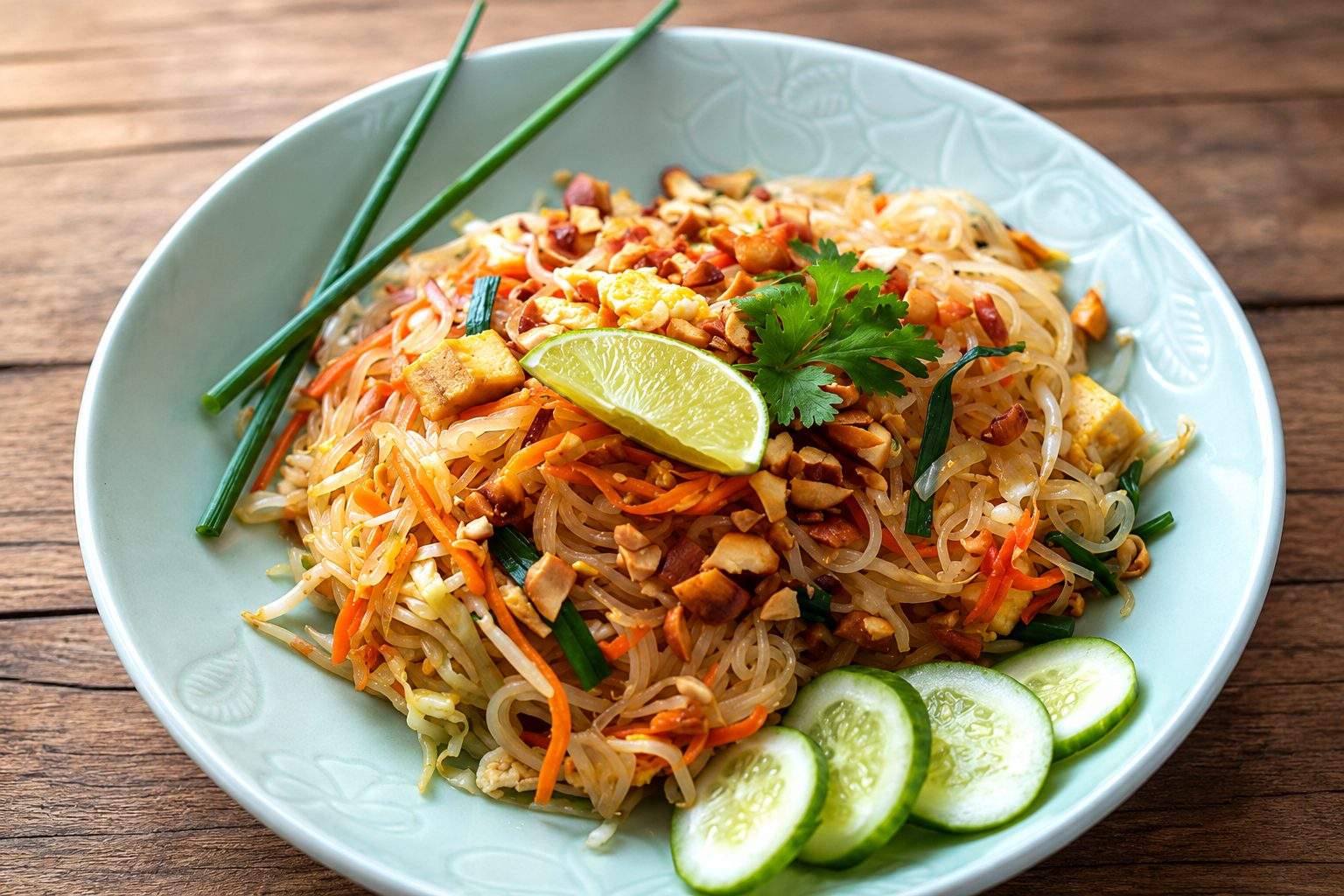
Le Pad Thaï est sans doute le plat thaïlandais le plus connu au monde. Derrière cette recette de nouilles sautées se cache pourtant un plat beaucoup plus subtil qu’il n’y paraît. En Thaïlande, un bon Pad Thaï est léger, peu saucé et and perfectly balanced between tamarind, palm sugar, fish sauce et le citron vert. Après avoir vécu plusieurs années en Thaïlande et goûté des centaines de versions différentes – chaque cuisinier possède sa propre manière de préparer ce grand classique de la cuisine thaïlandaise – je te partage aujourd’hui la recette que je prépare à la maison.
🇹🇭 In Thailand
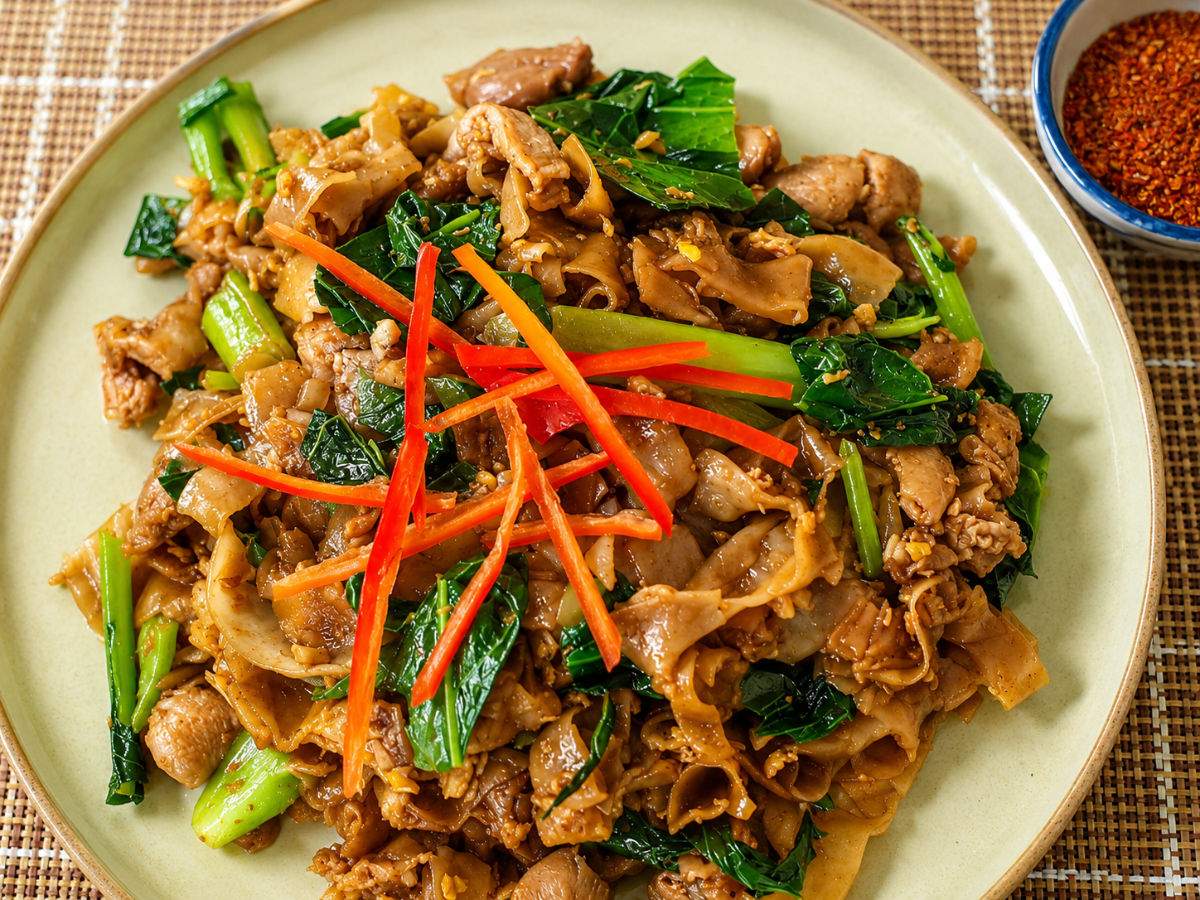
Le Pad Thaï est probablement plus célèbre à l’étranger qu’en Thaïlande ! Si les touristes le commandent presque systématiquement, les Thaïlandais, eux, alternent volontiers avec une multitude d’autres plats de nouilles sautées. Dans le sud de la Thaïlande où j’habite, on trouve bien davantage de Pad See Ew, Pad Kee Mao ou Rad Na.
Des pad thai, j’en ai mangé des centaines
Quand tu es Européenne et que tu aimes bien manger plein de choses variées, ce n’est pas facile de vivre sur une petite île perdue sans supermarché ni resto international. Cela implique de te nourrir de riz à tous les repas. Je te jure qu’après 15 jours à ce régime, tu rêves d’une purée de pommes de terre, d’un sandwich à n’importe quoi ou de pâtes, même sans sauce. Sauf que bien sûr, sur mon île, rien de tout cela !
Ce qui se rapproche le plus d’un plat de pâtes et qui ne contient pas de grains de riz, c’est le pad thai. Le pad thai, c’est pas cher, c’est pas du riz, c’est vite préparé et c’est bon : plein de raisons pour qu’il finisse dans mon estomac.
The “one and only authentic” Pad Thai recipe
Le pad thai est un plat qu’on mange pour 50 baht dans un restaurant de rue (généralement il coûte entre 40 et 100 baht). Pour te livrer cette recette, j’ai fait des recherches : j’ai potassé mes livres de cuisine thaïe, demandé à Google de me révéler « la vraie recette authentique » et interrogé mes voisins… eh ben … j’ai pas été très aidée : There are as many Pad Thai recipes as there are cooks!
La véritable recette authentique est une chimère. C’est vrai, qu’ici, dans les restaurants, je n’ai jamais mangé 2 fois le même pad thai : les goûts varient beaucoup et les ingrédients également.
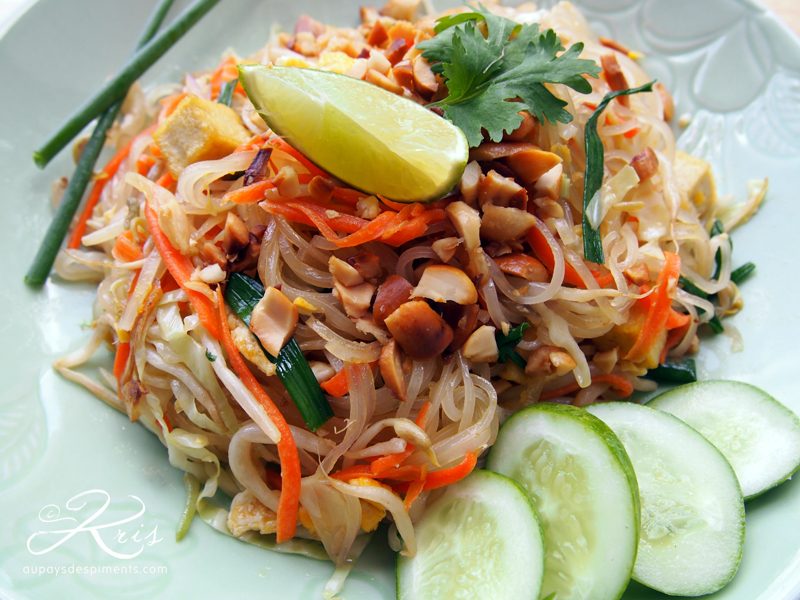
Du coup, j’ai fait beaucoup d’essais pour pouvoir fièrement te présenter ce qui est pour moi la meilleure recette de pad thai, celle comme j’aime le manger :
– avec tofu and bean sprouts,
– en utilisant de l’oignon vert rather than Chinese chives, also known as garlic chives;
– préparé avec vegetables : such as carrots and cabbage;
– avec a tamarind sauce that isn’t overly sweet;
– si noodles that are just cooked through, never soft or mushy.
Libre à toi d’ajouter ou de retirer ce que tu veux !
La sauce Pad Thaï : le secret d’un Pad Thaï réussi
Ce qui fait un délicieux pad thai, c’est avant tout la sauce. C’est hyper facile de préparer une sauce au tamarin maison, tu peux même la préparer en grand quantités et la conserver au frigo ou la congeler pour en avoir toujours sous la main.
Attention : Le pad thai n’est pas un plat en sauce. The sauce acts as a seasoning, coating the noodles as they cook. By the end of cooking, it should be completely absorbed by the rice noodles..
🌿 Pad Thai Sauce Recipe
Basic quantities for 2 servings—multiply as needed
2 garlic cloves, finely chopped
1 shallot, thinly sliced
3 tbsp palm sugar
2 tbsp fish sauce
2 tbsp tamarind paste
Fais revenir l’ail et l’échalote jusqu’à ce qu’ils soient tendres et translucides, ajoute le reste des ingrédients et fais chauffer jusqu’à ce que le sucre soit complètement fondu. Tu peux laisser bouillir quelques minutes pour épaissir la sauce si tu le souhaites.
Store in an airtight jar in the fridge or freeze for later use.
How to adjust the sauce to your taste
L’acidité du tamarin varie beaucoup en fonction de sa provenance ou de la marque de concentré que tu utilises. Il est important de goûter la sauce pour qu’elle soit bien équilibrée entre l’acidité, la salinité, la douceur. Si ta sauce est trop acide, ajoute du sucre pour balancer le tamarin. Si tu la trouves fade, ajoute de la sauce de poisson et une pointe de sucre pour relever le goût. Et si elle est trop douce à ton goût, ajoute davantage de tamarin.
🌿 Le tamarin : l’ingrédient qui donne son identité au Pad Thaï
Le tamarin est l’un des ingrédients essentiels de la sauce Pad Thaï. Sa pulpe apporte une mild, slightly fruity acidity qui équilibre parfaitement la richesse de la sauce poisson et la douceur du sucre de palme. C’est cet équilibre subtil entre l’acide, le salé et le sucré qui fait tout le charme d’un bon Pad Thaï.
Unlike lime, which is added just before eating, tamarind is incorporated directly into the sauce and flavours the noodles while they cook. Its distinctive taste cannot truly be replicated with vinegar or lemon juice, although these substitutes are sometimes suggested.
💡 My tip: utilise de la pulpe de tamarin ou une pâte de tamarin de bonne qualité, sans sucre ajouté. Certaines marques sont déjà très concentrées, d’autres plus liquides : n’hésite pas à ajuster la quantité selon leur intensité et à goûter la sauce avant de la verser dans le wok.
Concentré de tamarin maison :
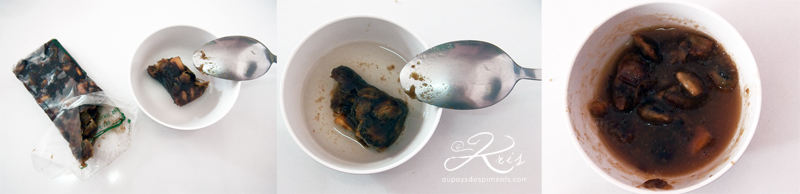
Le tamarin se trouve sous forme de pulpe de fruit compressée. Cela comporte les noyaux du fruit également. Pour pouvoir l’utiliser, on ajoute un peu d’eau chaude sur la pulpe et on laisse reposer quelques minutes. On mélange bien et on récupère la purée, on laisse les noyaux de côté. Tu peux te référer à ce post this post for detailed instructions on preparing tamarind for the sauce.
Il existe aussi du concentré de tamarin tout prêt qu’on trouve dans les supermarchés en bocal ou congelé. Fais attention de ne pas en mettre trop si tu l’utilises. La sauce pour le pad thai doit être légèrement acidulée.
🌴 Le sucre de palme : bien plus qu’une touche sucrée
Le sucre de palme est l’autre ingrédient incontournable de la sauce Pad Thaï. Contrairement au sucre blanc, il ne sert pas seulement à sucrer le plat : il apporte des delicate caramel and honey notes qui adoucissent l’acidité du tamarin et équilibrent le côté salé de la sauce poisson.
En Thaïlande, on utilise traditionnellement du sucre de palme fabriqué à partir de la sève des fleurs de palmier. Son goût est plus complexe et moins agressif que celui du sucre blanc, ce qui permet d’obtenir une sauce plus ronde et harmonieuse.
💡 My tip: privilégie un véritable sucre de palme thaï, vendu en galettes ou en pâte. Il est souvent assez ferme : il suffit de le râper ou de le couper en petits morceaux pour qu’il fonde plus rapidement dans la sauce. Si tu n’en trouves pas, le sucre de coco constitue une bonne alternative, même si son goût est légèrement différent.
Which noodles should you use for Pad Thai?
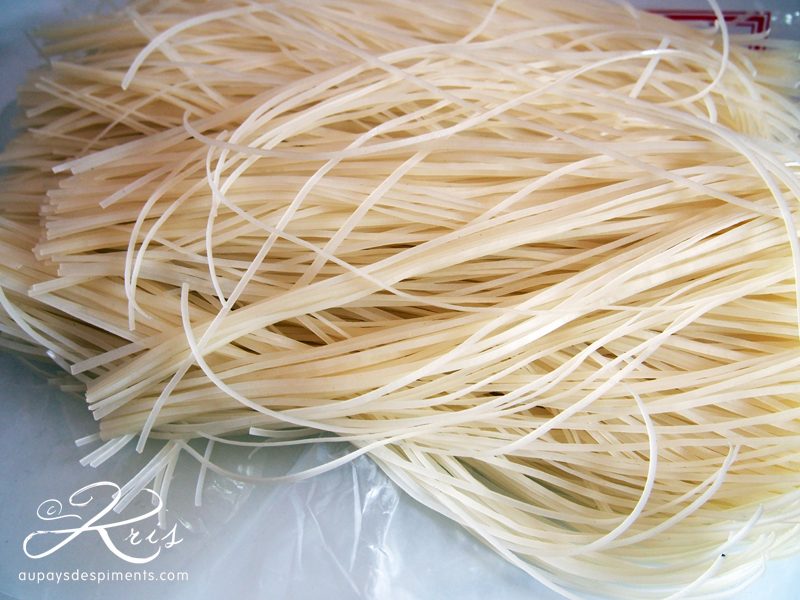
Choose flat rice noodles approximately 2–3 mm wide de largeur. Les nouilles rondes ne conviennent pas pour ce plat. Ces nouilles plates se trouvent fraîches (au marché de mon village) ou séchées. J’imagine qu’en Europe tu ne trouves pas les fresh noodles. Ici, c’est les sèches que je ne trouve pas.
To rehydrate dried noodles, réhydrater les nouilles séchées en les trempant dans de l’eau FROIDE durant 15 minutes environ. Quoi qu’il soit expliqué sur l’emballage des nouilles, ne le lis pas. C’est important de ne pas précuire ou ébouillanter les nouilles avant l’usage, autrement tu auras un pad thai avec des nouilles toutes visqueuses. Il ne faut pas trop tremper les nouilles, 15 à 20 minutes suffisent, tu dois juste pouvoir les plier sans qu’elles cassent.
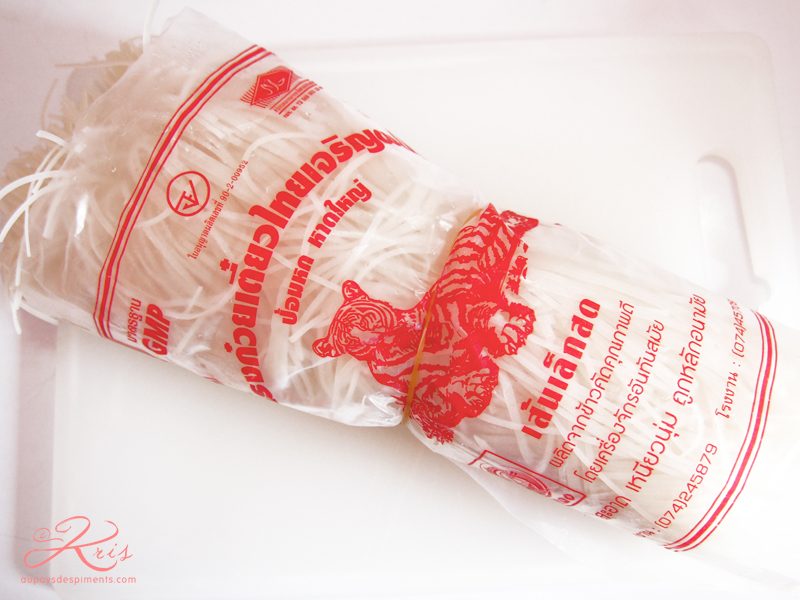
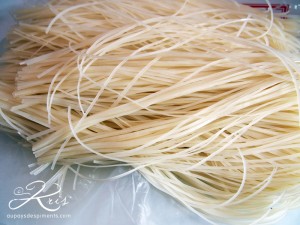
🌿 Which noodles should you choose? At a glance
Type : nouilles de riz
Ideal width: 2–3 mm
Fresh or dried: either
Comment les réhydrater : 15 min dans l’eau froide
Tofu
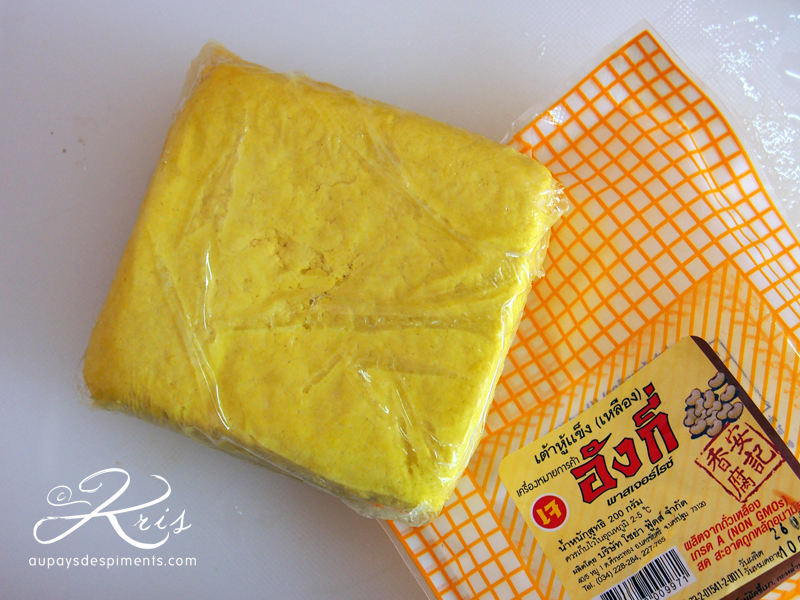
Choose extra-firm tofu, celui qui a une couleur jaune est parfait pour le pad thai. Tout autre tofu ferme convient également. J’aime le tofu quand il est bien croustillant à l’extérieur, je le fais donc revenir dans de l’huile avant de l’intégrer à mon plat.
🌶️ Did you know?
Le Pad Thaï est une recette relativement récente. Il aurait été popularisé dans les années 1930-1940 par le gouvernement thaïlandais, qui souhaitait promouvoir un plat national à base de nouilles de riz. Inspiré des techniques de cuisson chinoises, il est devenu au fil des décennies l’un des symboles de la cuisine thaïlandaise dans le monde.
Son succès international vient de l’équilibre entre le sucré, le salé, l’acidulé et l’umami, ainsi que de sa préparation rapide au wok.
My trick for making things easier
La chose important sur laquelle il ne faut pas se louper, c’est la cuisson des nouilles. Il n’y a rien de plus mauvais qu’un pad thai avec des nouilles trop cuites or noodles swimming in too much liquid.
Here, everything is traditionally cooked in a wok. First the noodles, then the meat or prawns, followed by the eggs and finally the vegetables.
You need to be a real wok expert to manage the timing so that every ingredient is perfectly cooked without being overdone.
C’est super stressant. On a besoin d’une gigantesque poêle pour ne pas avoir tout qui sort de tous les côtés. Si on cuisine pour plusieurs, il faut être super musclé pour tout remuer. Autant te dire que je ne suis pas un as du wok et que je préfère largement ma poêle anti-adésive pour ce type de cuisson car on utilise moins d’huile.
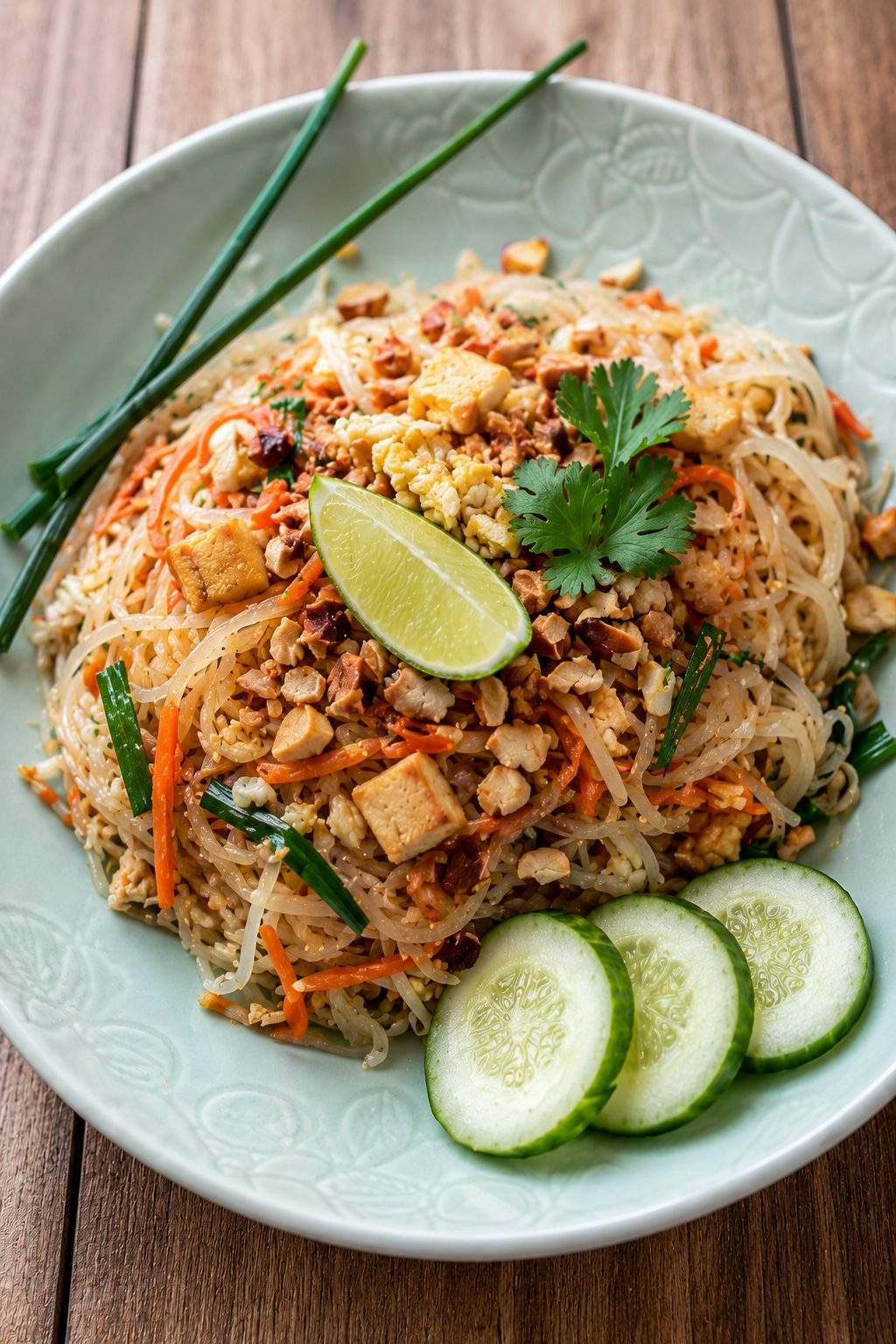
J’ai donc développé my own method for stir-fried noodles and fried rice: je cuis tous les éléments séparément, les uns après les autres, tranquille pépère. En fin de cuisson, je regroupe le tout dans la poêle et mélange bien. Cela déclenche généralement une horde de commentaires de la part de Nan mais il a reconnu que le goût du plat, au final, n’est pas différent de celui de la cuisson tout-en-un. Pour ce plat, je te conseille de faire comme moi et de cuire les ingrédients séparément.
Mistakes to avoid when making Pad Thai
❌ Cooking the noodles like pasta
Il n’est pas nécessaire de cuire les nouilles de riz dans de l’eau bouillante. Il est préférable de les tremper 15 minutes dans l’eau froide pour les attendrir, et de les faire cuire directement dans le wok grace à l’humidité de la sauce.
❌ Using too much sauce
Comme pour un risotto, les nouilles doivent absorber le liquide de la sauce. Le pad thai n’est pas un plat de nouilles en sauce, ce sont des nouilles sautées parfumées.
❌ Cooking the noodles for too long
Les nouilles de riz deviennent facilement pâteuses et collantes lorsqu’elles sont trop cuites. Il faut bien surveiller la cuisson et servir dès qu’elles sont tendres.
❌ Forgetting the lime
Le jus de citron vert donne une dimension supplémentaire au plat et lui apporte beaucoup de fraicheur. Ajouter quelques quartiers de citron vert sur la table (ou sur les assiettes) permet à chacun de l’ajouter à sa guise.
✨ Last updated: July 2026
This recipe has been reviewed and expanded with tips gathered from countless Pad Thai tastings at markets and street-food restaurants.
Frequently Asked Questions about Pad Thai
No. Chillies are generally added separately. A selection of seasonings is placed on the table, including dried chilli powder, vinaigre pimenté, sucre, sauce de poisson et citron vert. Chacun ajoute à son plat ce qu’il souhaite.
No, tamarind is essential to the sauce.
C’est l’un des ingrédients qui donnent au Pad Thaï sa saveur caractéristique. Son goût acidulé, légèrement fruité, est difficile à reproduire.
Traditional Pad Thai is made with firm tofu, qui garde sa texture pendant la cuisson. Il est généralement coupé en petits dés puis légèrement doré avant d’être mélangé aux nouilles. Évite le tofu soyeux, beaucoup trop fragile pour ce type de cuisson.
Le Pad Thaï est meilleur lorsqu’il est dégusté juste après la cuisson. Les nouilles restent souples et la sauce est parfaitement absorbée. Si tu souhaites gagner du temps, tu peux préparer tous les ingrédients à l’avance (légumes, sauce, tofu, crevettes…) et cuire le plat au dernier moment. La cuisson ne prend que quelques minutes.
Tu peux le préparer à l’avance pour le mettre dans une lunch box à manger plus tard. Mais évite de le réchauffer car les nouilles de riz deviendront collantes et pâteuses.
Ce n’est pas recommandé. Après décongélation, les nouilles de riz deviennent souvent molles et collantes, ce qui altère la texture du plat.
Choose a good-quality Thai fish sauce , préparée à partir d’anchois fermentés (un bon nuoc mam convien également). Elle apporte toute la profondeur et l’umami caractéristiques du Pad Thaï. Les marques comme Squid Brand, Megachef ou Tiparos sont faciles à trouver en épicerie asiatique. Évite les sauces poisson très bon marché, souvent plus salées et moins parfumées.
Oui, mais elles apportent une saveur umami discrète qui contribue au goût authentique du Pad Thaï. Si tu n’en trouves pas ou si tu préfères les éviter, tu peux simplement les supprimer ou les remplacer par un peu plus de tofu. La recette restera délicieuse, même si elle sera légèrement différente de la version traditionnelle.
Pad Thai can naturally be gluten-freebecause its noodles are made from rice flour. However, you should check the other ingredients, particularly the fish sauce, tamarind paste and any ready-made sauces, as they may contain wheat or additives. If you are intolerant to gluten, always read the labels carefully.
Les nouilles de riz collent généralement lorsqu’elles sont overcooked or soaked avant la cuisson. Elles doivent rester légèrement fermes lorsqu’elles entrent dans le wok, car elles finiront de cuire avec la sauce. Il est également important de cuire le Pad Thaï à feu vif et de le servir immédiatement pour préserver une texture parfaite.
Yes. For a vegetarian or vegan Pad Thai, replace the fish sauce with light soy sauce or a vegetarian mushroom-based sauce. The flavour will be different but still very enjoyable.
L’équilibre de la sauce est essentiel. Un Pad Thaï trop sec manque généralement de sauce ou a été cuit trop longtemps. À l’inverse, un Pad Thaï trop humide contient souvent trop de liquide ou des nouilles insuffisamment égouttées. Une cuisson rapide à feu vif permet d’obtenir des nouilles brillantes et parfaitement enrobées de sauce, sans excès de liquide.
A lime wedge is traditionally served alongside Pad Thai, so everyone can squeeze on as much juice as they like before eating. It adds freshness, balances the richness of the noodles and brings out the flavour of the tamarind.
Comme dans de nombreux plats thaïs, on aime ajouter une touche croquante. Cela se fait parfois avec des ingrédients frits ou avec des noix de cajou. Ici, on utilise généralement des cacahuètes concassées qu’on parsème au moment de servir.
D’autres recettes de nouilles
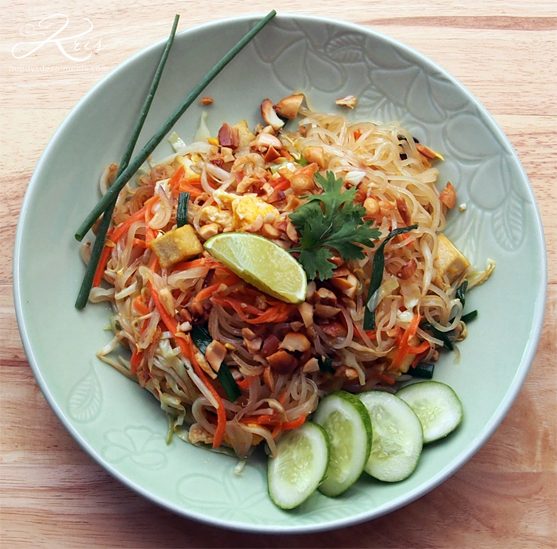
Chicken Pad Thai Recipe – Just Like in Thailand
Ingredients
- 120 g dried flat rice noodles 3 mm wide
- OR
- 300 grams fresh flat rice noodles 3 mm wide
- 100 grams thinly sliced chicken —the chicken can be replaced with prawns or omitted for a vegetable Pad Thai
- 2 cloves garlic
- 1 shallot
- 4 tbsp dried shrimp
- 100 g firm tofu
- 2 eggs
- 20 g Chinese chives or spring onions
- 100 g mixed vegetables, such as carrots, Chinese cabbage, white cabbage and bean sprouts
- 4 tbsp of peanuts roasted, unsalted, chopped
- 4 tbsp oil for cooking
- Sugar, chilli powder, fish sauce and lime wedges, to serve
Homemade tamarind sauce for Pad Thai
- 3 tbsp palm sugar
- 2 tbsp fish sauce
- 2 tbsp tamarind paste
Instructions
Rice noodles
- If using dried noodles, soak them in room-temperature water for 15 minutes, then drain thoroughly.
Sauce
- In a bowl, combine all the sauce ingredients.
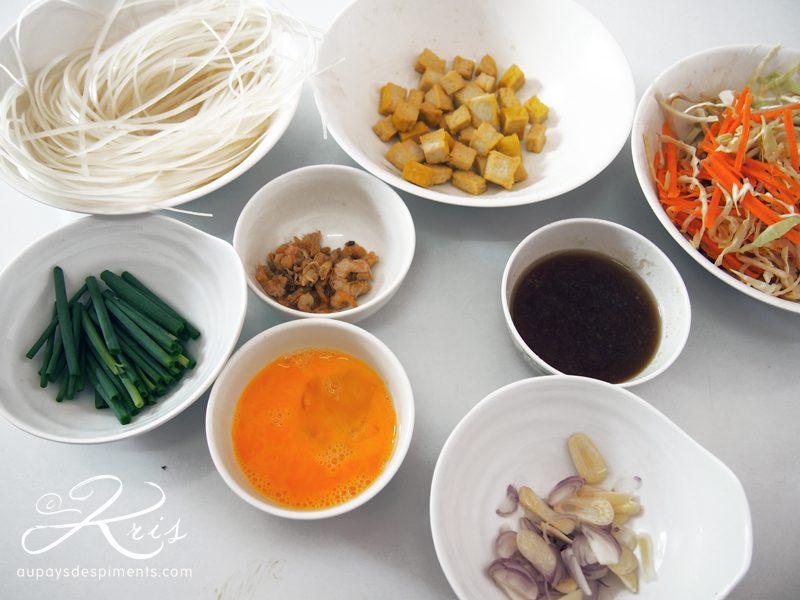
Preparing the ingredients
- Cut the tofu into 1 cm cubes.
- Cut the spring onions into 5–6 cm lengths.
- Peel the garlic and shallot, then slice them lengthways.
- Wash the vegetables and dry them thoroughly.
- Beat the two eggs with a fork in a bowl.
Cooking
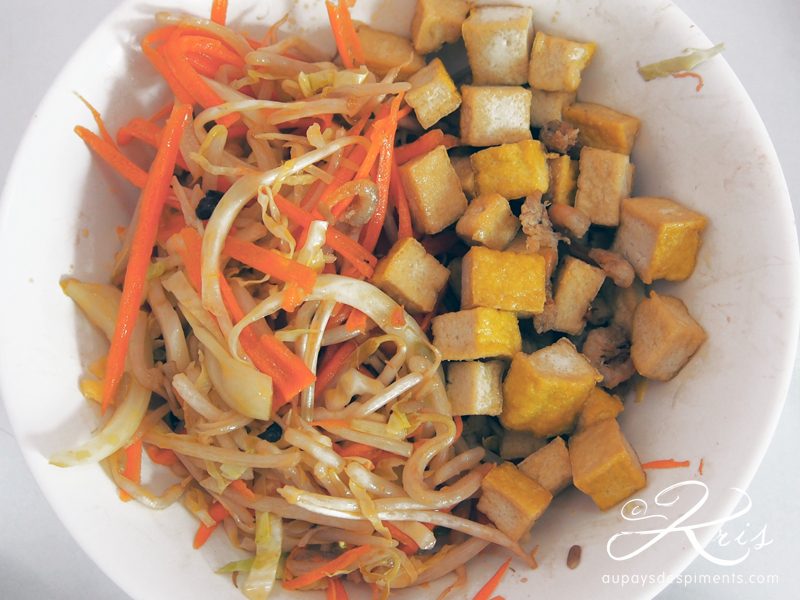
- Heat 2 tbsp oil in a large frying pan with fairly high sides. Fry the tofu cubes for 2 minutes, until crisp on the outside. Remove them from the pan and set aside.
- Fry the dried prawns for 1–2 minutes, until crisp. Remove them from the pan and set aside.
- Wipe the pan clean, then heat 1 tsp oil. Stir-fry the bean sprouts, carrots and cabbage until just tender, taking care not to overcook them. Remove the vegetables from the pan and set aside.
- Add 1 tbsp oil to the pan and sauté the garlic and shallot. Add the sliced chicken and cook until lightly browned.
- Add the noodles and sauce. Cook over low heat, stirring constantly. If the noodles are taking too long to soften, add 2–3 tbsp water—but only a little at a time, as too much liquid can make them mushy.
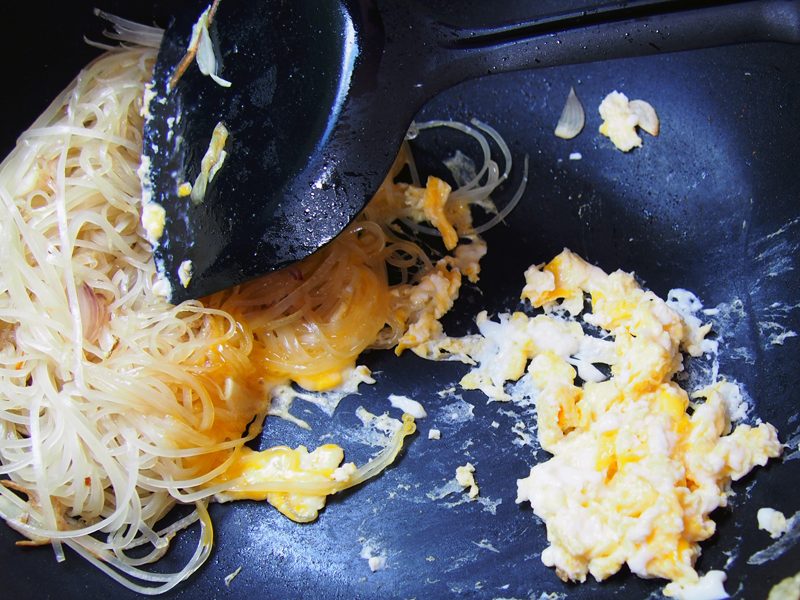
- Once the noodles are tender and no longer firm in the centre, push them to one side of the pan. Increase the heat and pour the beaten eggs into the empty space.

- Stir the eggs as they cook. Once set, mix them into the noodles.
- Return all the previously cooked ingredients to the pan and add the spring onions. Cook for 1 minute, mixing everything thoroughly, then remove from the heat.
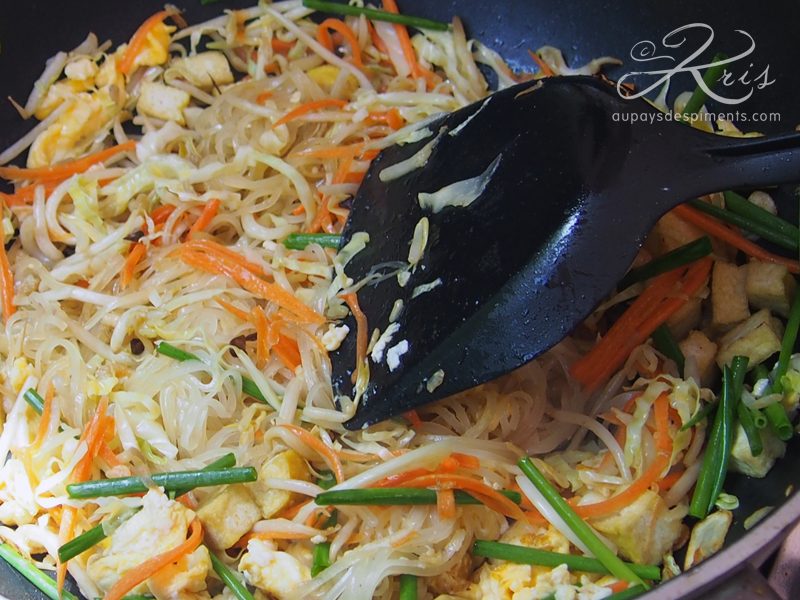
- Sprinkle the chopped peanuts over the Pad Thai.
- Serve immediately with lime wedges, fish sauce for those who prefer a saltier flavour, sugar for those who like it sweeter, and chilli powder for anyone who enjoys a little heat!
 English
  Français
nous rentrons tout juste d’un voyage en thailande, on a adoré et surtout la cuisine. le pad thai c’est délicieux mais j’ai encore plus aimé le pad si hiew c’est vraiment excellent ces pates larges mélangées avec cette sauce. je trouve beaucoup de recettes du pad htai, je vais d’ailleurs essayer la tienne séparément quand on est pas un as de la cuisine thai je pense que c’est judicieux, mais je ne trouve pas de recette concernant ces nouilles larges
pourrais tu m’aider
merci d’avance
sandra
Merci et tous mes vœux également. Philippe
Hello Kris,
Je vis a Phuket depuis 2010, mais en ce moment je suis en France jusqu’en juillet… Ensuite je retourne a Phuket définitivement. J’y travaille, j’ai un petit hôtel.
Ho que oui le Kaeng Som…Ici on en trouve a tous les coins de rue.. J’apprécie beaucoup la cuisine Thaï…Je goute a tout et depuis que je suis de passage en France, tout me semble si fade….Même le foie gras !!!!! Ceci dit, du foie gras au piment ???
Jái cru comprendre que tu es plutôt coté golfe de Thaïlande? Je sais que coté Andaman, il ne fait pas très beau, pas comme il devrait faire en fait…..
Bonne continuation.
Philippe
Je suis aussi du côté de la mer d’Andaman, mais tout au Sud, près de la frontière avec la Malaisie. En fait, c’est chaque année la même chose : pluie les 2 dernières semaines de décembre. Là, on va avoir 2 semaines de vent violent et de vagues puis ensuite on aura le soleil et le chaud pour plusieurs mois.
Tous mes voeux pour cette nouvelle année ! 😀
Kris
Hello,
Bravo pour ton blog déjà, que j’ai découvert un peu au hasard. Je suis un gourmand de nature et fan de cuisine thaïe.. Il vaut mieux, je vis a Phuket.. Tes recettes sont particulièrement alléchantes, je vais essayer également de me lancer dans les currys, mais c’est vrai que, généralement, on arrive a en trouver d’excellents.
Pour ce qui est du Pad Thaï, je suis toujours étonné de voir cet engouement vis a vis de ce plat, que l’on ne trouve que dans la rue en fait… Chaque fois que je vais manger dans une famille thaïe, et que je demande s’ils le cuisinent, ca les fait toujours rire… Je pense qu’il a plus de succès envers les occidentaux pour des raisons évidentes…C’est un des rares qui ne soit pas épicé… Mais de là á lui affliger le titre de ‘plat national ‘je trouve que c’est un peu excessif non??
A bientôt
Philippe
Bonjour Philippe,
Phuket est une île que j’aime beaucoup, on y trouve vraiment de tout, y compris des endroits hors de la foule et des tonnes de bon restos ! Tu y habites à l’année ? Tu y travailles ?
Je suis contente que mes recettes te plaisent, ça va être facile pour toi de trouver tous les ingrédients 🙂
Honnêtement, les pâtes de curry que tu trouves fraîches sur les marchés de Phuket sont délicieuses (si tu aimes le piment), ça ne vaut pas vraiment la peine de mettre la cuisine sans dessus dessous pour les préparer, autant les acheter. Quoi que j’ai remarqué des grandes différences de goûts entre les pâtes vendues par un marchand et l’autre. Il m’a fallu plusieurs essais pour trouver la meilleure pâte de curry de la ville où j’habite 🙂
En ce qui concerne le Pad Thai, tu as raison. Il est très peu consommé par les locaux (en tous cas dans le sud de la Thaïlande) je n’ai jamais vu une de mes connaissances ni un de mes collègues en manger. Par contre, ils mangent volontiers d’autres types de nouilles sautées.
Si tu me demandes quel est le plat national thaï, ce n’est effectivement pas le Pad Thai que je citerais en premier. Je pense que je te répondrais : l’omelette et le Gaeng Som 😉 ou pourquoi pas la salade de papaye verte …
J’espère qu’à Phuket vous avez moins de pluie qu’ici.
Bonne semaine
Kris
Hummm un de mes plats préférés, si simple et à chaque fois ça en jette 😉
Ton pad thai est super appétissant avec toutes ces couleurs, tu me mets l’eau à la bouche !
😀 merci !
Quand tu le prépares, que mets-tu dedans ?
Hahaha je me demande comment j’ai pu croire que c’était une som tam, en fait je n’ai pas pensé au Pad Thai une seconde. Je dois dire qu’en Thaïlande je n’en ai pas mangé, j’ai eu l’impression que c’était un peu un truc de touriste et snob comme je suis, dans le doute j’ai évité 🙂 Je dois dire que ta recette me donne vraiment envie d’essayer, surtout que tu apportes enfin une solution à un épineux problème : cette cuisson au wok qui me parait assez insurmontable. Je crois que je vais me lancer, mon chéri serait aux anges ! Je te fais signe pour te raconter!! Bises
Trop drôle 😀
En fait, Nan pense exactement cela … il dit que le pad thai c’est bon pour les enfants et les touristes 🙂
Mais pour lui, il n’y a que le curry, le poisson frit et l’omelette qui composent un repas valable.
Dans le sud de la Thaïlande, les gens mangent plus volontiers les larges nouilles sautées (pad si hiew) plutôt que le pad thai.
Quand à la cuisson au wok, j’ai jeté l’éponge il y a bien longtemps. J’utilise le wok uniquement pour préparer la fameuse omelette thaïe à laquelle je consacrerai un post bientôt.
Quoi qu’il en soit, ça m’intéresse de savoir ce que tu penses de ce plat si tu essaies car un p´tit pad thai de temps en temps, ça passe, même si on est snob 😉
Gros becs
Kris
En lisant ton commentaire sur mon blog, je suis venue visiter le tien… Et là… Quelle surprise! Toute la famille est tombée amoureuse de ce merveilleux pays qu’est la Thaïlande et de sa cuisine également! Le pad thaï est devenu (entre autres) un incontournable à la maison et je sens bien que ton site va devenir un incontournable pour moi désormais! Quelle jolie découverte!
Merci beaucoup, j’espère que tu trouveras ton bonheur parmi les recettes publiées 🙂
Ce matin, ton pain irlandais m’a fait de l’oeil, il n’y a aucun doute, on va se donner des nouvelles 😉
Belle semaine à toi et à bientôt
Kris
Salut, je suis vraiment intéressée de lire ce que tu partages sur la cuisine thaï.
Ta manière d’adapter ces recettes pour des cuisiniers non Asiatiques me plait beaucoup.
Cette cuisine est tellement délicieuse!Merci vraiment, c’est passionnant.
Bonjour Pauline,
Merci pour ton message, cela me touche beaucoup. Bienvenue parmi nous !
J’essaie d’expliquer les différentes étapes par lesquelles mon cerveau passe quand je cuisine thaï. Il m’a fallu du temps pour comprendre comment apprivoiser cette manière de cuisiner bien différente de la notre.
N’hésite pas à me faire part de tes impressions si tu essaies certaines recettes. Bonne semaine et à bientôt, j’espère.
Kris
notre voyage en Thaïlande a été pour nous un pur bonheur!!
Les pad thai …..c’est divin!! on en a beaucoup mangé…. et plein d’autres choses aussi. On est très très gourmand. La cuisine asiatique me renverse. Je suis mariée à un Laotien et ma belle famille ne cuisine que du Lao donc autant te dire que je raffole de cette cuisine. Tes pad thai ont l’air délicieuse. Bonne continuation culinaire dans ce merveilleux pays.
Biz
… la gourmandise… je connais 😉 je suis tombée dedans quand j’étais petite 😀
Par contre, je ne connais pas du tout la cuisine Laotienne. Est-ce semblable à la cuisine thaïe, au niveau des goûts et des types de préparation ?
Kris